







The world of watersports has been revolutionized by a remarkable innovation that seemingly defies gravity and friction: the electric hydrofoil board, commonly known as an eFoil. Imagine gliding effortlessly above the water’s surface, silently and smoothly, regardless of wind or waves. This is the promise of eFoil technology, a perfect blend of advanced hydrodynamics, powerful electric propulsion, and intuitive control systems.
 |
 |
How eFoils Fly
To understand eFoil technology, one must first grasp the concept of hydrofoiling. A hydrofoil is essentially an underwater wing attached to struts below the hull of a watercraft. As the craft gains speed, the hydrofoil generates lift in much the same way an airplane wing generates lift in the air.
When the lift generated by the hydrofoil exceeds the weight of the board and the rider, the hull lifts completely out of the water. This dramatically reduces hydrodynamic drag (the resistance of the water against the hull). The result? Increased speed, improved battery efficiency, and a famously smooth, almost silent ride, as the board is no longer interacting with surface chop or small waves.
The “e” in eFoil stands for electric. Traditional hydrofoil boards require external forces to generate the necessary speed for lift—typically a kite (kitefoiling), a sail (windfoiling), a boat (wakefoiling), or simply riding a wave (surf foiling). An eFoil integrates an electric motor directly into the hydrofoil assembly, making it completely self-propelled and independent of wind or waves.
eFoil Key Components
An eFoil is a sophisticated piece of engineering comprising several crucial elements that must work in perfect harmony.
1. The Board
The board is the rider’s platform. While it might look similar to a thick surfboard, its design is optimized for a very specific purpose.
-
Volume and Flotation: The board needs enough volume (measured in liters) to support the rider’s weight when stationary in the water. Beginners typically start with larger, higher-volume boards (e.g., 90+ liters) for stability. Advanced riders favor smaller, lower-volume boards for increased maneuverability and a more aggressive carving experience, even though these smaller boards require more skill to get on a plane.
-
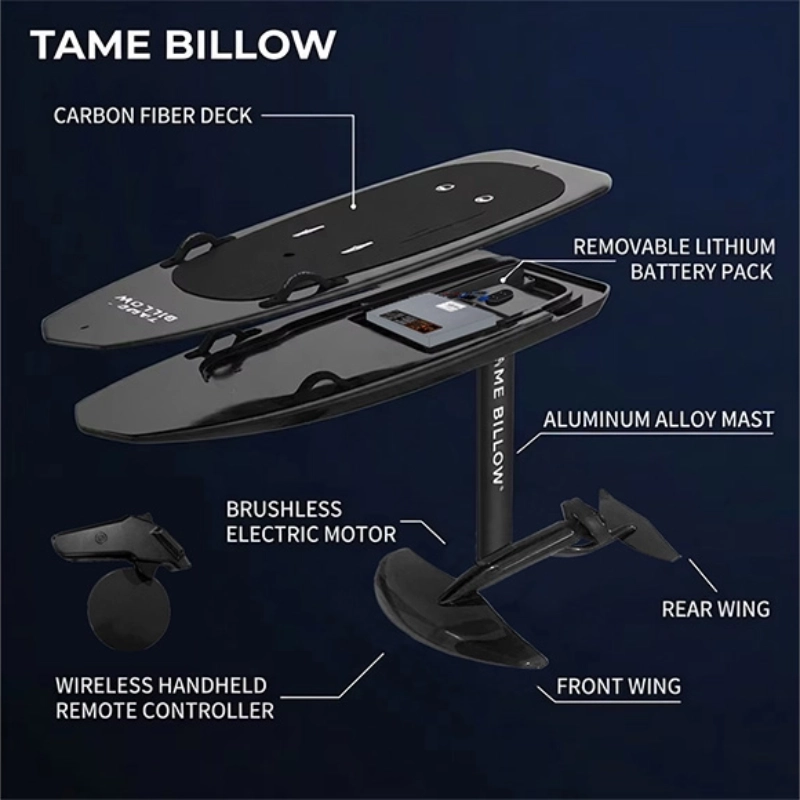
Construction: Modern eFoil boards are constructed using lightweight and rigid materials to maximize performance and battery life. Carbon fiber is the gold standard, offering an exceptional strength-to-weight ratio. Fiberglass and epoxy composites are also common, often utilized in more accessible or entry-level models.
-
Design Features: The hull shape often includes specific design elements to help the board release from the water quickly during takeoff. A non-slip EVA deck pad provides essential traction for the rider. Inside the board lies a waterproof compartment that securely houses the critical electronic components, primarily the battery and the Electronic Speed Controller (ESC).
2. The Mast – Strut
The mast is the vertical column connecting the board to the fuselage and wings. It plays a significant role in the riding experience.
-
Length: Mast lengths vary, typically ranging from 60cm to 90cm.
-
Shorter Masts (e.g., 60-70cm): Ideal for beginners and riding in shallow waters. They are more forgiving; if the wing breaches the surface, the drop back to the water is less severe.
-
Longer Masts (e.g., 80-90cm): Preferred by experienced riders. They allow for steeper carving angles without the board touching the water and provide a smoother ride in choppy conditions, as the wings are deeper below the surface turbulence.
-
-
Material: Like the board, masts are usually constructed from carbon fiber or high-grade aluminum. Carbon fiber offers superior stiffness and reduced weight, crucial for responsive handling, while aluminum provides excellent durability at a more accessible price point.
3. The Wings – Front and Stabilizer
The wings are the heart of the hydrofoil system, responsible for generating lift and providing stability.
-
Front Wing: This is the primary lifting surface. Its size and shape drastically affect the eFoil’s performance characteristics.
-
Surface Area: Larger wings (e.g., 1500cm²+) generate lift at lower speeds, making them perfect for beginners, heavier riders, and cruising. Smaller wings (e.g., under 1000cm²) require higher speeds to generate lift but offer much less drag, allowing for higher top speeds and more aggressive carving.
-
Aspect Ratio (AR): This is the ratio of the wing’s wingspan to its chord (width).
-
Low AR Wings: Shorter and wider. They provide a lot of lift at slow speeds and are very maneuverable and forgiving.
-
High AR Wings: Long and thin (like a glider plane wing). They are incredibly efficient, offering excellent glide, higher top speeds, and extended battery life, but require more skill to control and turn.
-
-
-
Stabilizer (Rear Wing): Positioned behind the front wing on the fuselage, the stabilizer (or tail wing) counteracts the lift of the front wing, providing pitch stability (preventing the nose from continuously rising or diving). Its size and angle can often be adjusted to tune the board’s responsiveness.
4. The Propulsion System – Motor and Propeller
This is what makes the eFoil self-propelled.
-
The Motor: eFoils utilize powerful brushless electric motors, typically situated at the bottom of the mast, directly in line with the fuselage. These motors need to be completely waterproof and robust enough to handle the harsh marine environment. They are designed for high torque to push the board up to speed quickly.
-
The Propeller: The propeller translates the motor’s rotational power into thrust. Propeller design involves complex fluid dynamics to maximize efficiency and speed while minimizing cavitation (the formation of low-pressure bubbles that reduce thrust and cause noise).
-
Safety Guards: Most eFoils feature a propeller guard or duct. This is a critical safety feature that protects the rider (and marine life) from the spinning blades. Some advanced models offer folding propellers to reduce drag when surfing waves without motor power.
5. The Battery
The battery is the heaviest and often most expensive component of an eFoil. It dictates the ride time and contributes significantly to the overall weight.
-
Technology: eFoils use high-capacity Lithium-ion (Li-ion) battery packs. These must be housed in robust, waterproof enclosures (typically IP68 rated).
-
Capacity and Ride Time: Battery capacity is measured in Watt-hours (Wh) or Amp-hours (Ah). Depending on the battery size, rider weight, wing setup, and riding style (cruising vs. aggressive carving), ride times can range from 45 minutes to over 2 hours on a single charge.
-
Safety: Modern eFoil batteries incorporate sophisticated Battery Management Systems (BMS) that monitor temperature, voltage, and current to ensure safe charging, discharging, and longevity.
6. The Hand Controller
The hand controller is the rider’s interface with the eFoil, managing speed and providing essential information.
-
Design: Controllers are ergonomically designed to be held comfortably in one hand and are, of course, fully waterproof. They communicate with the board’s ESC via a secure wireless connection (usually Bluetooth).
-
Throttle Control: Speed is typically controlled via a trigger mechanism. The sensitivity of the trigger allows for precise speed adjustments, crucial for taking off, maintaining flight, and maneuvering.
-
Features: Most controllers feature a digital display that provides real-time telemetry, including battery level (for both board and controller), current speed, power output, and selected power modes. Many systems offer different power profiles (e.g., beginner, eco, sport) to limit maximum speed or acceleration, catering to different skill levels.
-
Safety Cut-off: A critical safety feature is the dead man’s switch. If the rider falls off and the controller hits the water (or connection is lost), the motor instantly shuts down, preventing the board from accelerating away.
The Physics of Flight: Lift, Drag, and Balance
Riding an eFoil is a delicate balancing act of forces.
-
Acceleration: The rider pulls the trigger, and the electric motor spins the propeller, generating forward thrust.
-
Generating Lift: As the board accelerates across the water, water flows over the distinct shape of the front wing. The wing is designed with an asymmetric profile (camber) or an angle of attack that causes water to move faster over the top surface than the bottom. According to Bernoulli’s principle, this creates lower pressure on top and higher pressure underneath, generating upward lift.
-
Takeoff: When the speed increases sufficiently, the lift generated by the wings overcomes the total weight of the board, battery, and rider. The hull breaks free from the water’s surface, and drag is drastically reduced.
-
Maintaining Flight (Pitch Control): Once flying, the rider must control the pitch (up/down angle) of the board. This is achieved entirely through weight distribution. Shifting weight to the back foot increases the angle of attack of the front wing, generating more lift and causing the board to rise. Shifting weight to the front foot decreases the angle of attack, lowering the board. Finding the “sweet spot” of balance is the key to sustained, level flight.
A Comparison of Wing Types
Choosing the right wing is crucial for the eFoil experience. Here is a brief comparison:
|
Wing Type |
Aspect Ratio |
Pros |
Cons |
Ideal User |
|
Cruiser/Beginner |
Low to Medium |
High lift at low speed, very stable, forgiving, easy takeoff. |
Lower top speed, more drag, feels “sluggish” in tight turns. |
Beginners, heavier riders, relaxed cruising. |
|
Sport/Carve |
Medium |
Good balance of lift and speed, highly maneuverable, responsive. |
Requires slightly higher takeoff speed, less stable than cruiser wings. |
Intermediate riders, carving, wave riding. |
|
High Aspect (Glide) |
High |
Extremely efficient, long glide, high top speed, excellent battery life. |
Requires higher takeoff speed, less maneuverable, requires more precise balance. |
Advanced riders, long-distance riding, maximizing speed. |
The Future of eFoil Technology
The eFoil industry is relatively young, and technology is evolving rapidly. We can anticipate several exciting trends in the near future:
-
Improved Battery Technology: The relentless push for lighter, higher-density batteries will continue. This will result in eFoils that are lighter (making them easier to transport and more agile) and offer significantly longer ride times. Solid-state battery technology could eventually play a major role here.
-
Advanced Materials and Manufacturing: The use of lighter and stronger composite materials will become more widespread, perhaps making high-end carbon fiber construction more accessible.
-
Smarter Electronics: We can expect more sophisticated ESCs and integrated sensors. This could lead to active stabilization systems (similar to those in drones) that help beginners balance, or more advanced telemetry data for performance analysis.
-
Folding Propellers and Jet Drives: While folding propellers exist, their design and efficiency will improve, appealing to riders who want to seamlessly transition from powered riding to unpowered surfing on waves. Additionally, fully enclosed jet drive systems may become more prevalent, offering different performance characteristics and potentially increasing safety by eliminating exposed propeller blades.
eFoil technology has fundamentally changed how we interact with water. By combining the serene feeling of flight with the accessibility of electric power, it offers an unparalleled watersports experience. As the technology continues to mature, becoming lighter, more efficient, and perhaps more affordable, the sight of riders silently gliding above the waves will only become more common.
TAME BILLOW eFoil – Your Best eFoil Choose
 |
Color: Black or customized
BoardBoard Material: EPS core + Carbon fiber+epoxy resin
Motor powerWattage: 8000W or customized |
FAQ
1. Is it difficult to learn how to eFoil?
While it looks magical, learning to eFoil is generally considered easier than learning to kiteboard or surf, especially with proper instruction. Most people with basic balance and water confidence can get up and flying during their first session. Starting with a large board and a large front wing makes the learning curve much smoother, as they provide stability and generate lift at lower speeds.
2. How long does the battery last on a single charge?
Battery life depends on several factors, including the battery’s capacity, the rider’s weight, the wing size, and the riding style. Aggressive riding at high speeds drains the battery faster than relaxed cruising. On average, a standard eFoil battery will provide between 60 to 90 minutes of ride time. High-capacity batteries or very efficient riding setups can extend this to over two hours.
3. Are eFoils safe to use?
Like any motorized watersport, safety is paramount. Most eFoils are designed with essential safety features. The most critical is the automatic motor shut-off that activates the moment the hand controller is submerged or loses connection, preventing the board from running away. Furthermore, most systems include propeller guards to prevent contact with the blades. Riders are strongly advised to always wear a personal flotation device (PFD) and a helmet, especially while learning.
