







Imagine gliding silently above the water’s surface, untethered from the unpredictability of wind or the necessity of breaking waves. You are flying over the aquatic landscape, suspended in mid-air by a sleek wing cutting through the water below. This is not science fiction; this is the reality of eFoiling. Over the past few years, the electric hydrofoil has emerged as a definitive game-changer, spearheading a true water sports revolution.
Whether you are a lifelong surfer looking for flat-water thrills, a technology enthusiast captivated by cutting-edge engineering, or simply an adventurer seeking a new hobby, eFoiling offers an unparalleled experience. It combines the serene feeling of powder snowboarding, the aerodynamics of flight, and the accessibility of modern electric vehicles. This comprehensive guide will take you through every stage of the eFoil journey—from understanding the intricate mechanics of the board to mastering your first flight, and eventually carving aggressive turns like a seasoned expert.
What is an eFoil
Before you step onto the water, it is crucial to understand the machinery beneath your feet. An eFoil is a marvel of modern engineering, marrying hydrodynamics with high-output electrical systems. Understanding these components will not only help you ride better but also assist you in making informed purchasing decisions and performing proper maintenance.
The Core Components
An electric hydrofoil consists of several distinct parts that must work in perfect harmony. Below is a detailed breakdown of a standard setup.
|
Component |
Primary Function |
Ideal Material / Specs |
Beginner Recommendation |
|---|---|---|---|
|
The Board |
Provides buoyancy, houses the battery, and acts as the rider’s platform. |
Carbon fiber or EPS foam with fiberglass overlay. |
Large volume (100L+) for maximum stability. |
|
The Mast |
Connects the board to the fuselage/wings and houses the motor wiring. |
Aluminum or Carbon fiber (stiffer). |
Short mast (60cm – 70cm) to reduce crash height. |
|
The Front Wing |
Generates the hydrodynamic lift required to elevate the board. |
Carbon fiber (lightweight and rigid). |
Large surface area (1500cm²+) for low-speed lift. |
|
The Stabilizer (Rear Wing) |
Controls pitch and provides overall stability during flight. |
Carbon fiber. |
Larger stabilizer for predictable, smooth rides. |
|
Propulsion System |
Drives the board forward (Motor, Propeller, or Jet drive). |
Marine-grade aluminum, shielded propellers. |
Guarded propeller or fully enclosed jet drive. |
|
The Battery |
Powers the motor; usually lithium-ion. Dictates ride time. |
High-capacity Lithium-ion in a waterproof casing. |
Standard capacity (allows for 60-90 mins ride). |
|
The Hand Controller |
Regulates speed via a throttle trigger; connects via Bluetooth. |
Waterproof, ergonomic plastic with digital display. |
Controller with adjustable speed limit gears. |
The Science of the Lift
The magic of the eFoil lies in the front wing. Much like an airplane wing, it is shaped with a curved upper surface and a flatter lower surface. As the propulsion system pushes the board forward, water rushes over the wing. The water moving over the curved top travels faster than the water moving underneath, creating a pressure differential. This lower pressure on top creates lift. Once the lift exceeds the combined weight of the rider and the board, the magic happens: the board leaves the water, drag is virtually eliminated, and you enter a state of silent, frictionless flight.
How to Choosing Your First eFoil Setup
The market is currently flooded with various brands and configurations. Buying an eFoil is a significant investment, and selecting the right gear is paramount to your progression and safety.
Board Volume is King
For beginners, volume is your best friend. Volume dictates how buoyant the board is when stationary. If you weigh 80kg (175 lbs), trying to learn on a 50-liter pro board will result in endless frustration, as the board will sink the moment you try to kneel on it. Beginners should look for boards offering between 90 and 120 liters of volume. This allows the board to float easily with your full weight on it, meaning you can focus on throttle control and balance without worrying about sinking.
Mast Length
Masts typically range from 60cm to 90cm. A shorter mast (60-70cm) is highly recommended for novices. When you are learning, you will inevitably breach (when the front wing comes out of the water, causing a sudden loss of lift and a crash). A shorter mast means you are closer to the water, making falls less intimidating and safer. As you transition to intermediate and expert levels, a longer mast (80cm+) becomes essential for carving sharp turns without the rails of the board hitting the water.
Wing Selection
The front wing dictates the personality of your eFoil. Large wings (1500cm² to 2000cm²) are the heavy lifters. They generate lift at very low speeds (around 10-12 km/h) and offer a highly stable, predictable ride. The trade-off is top speed and agility. Smaller wings (under 1200cm²) are favored by experts; they require higher speeds to generate lift but allow for aggressive carving, riding ocean swells, and hitting top speeds exceeding 40 km/h.
TAME BILLOW eFoil – Your Best eFoil Choose
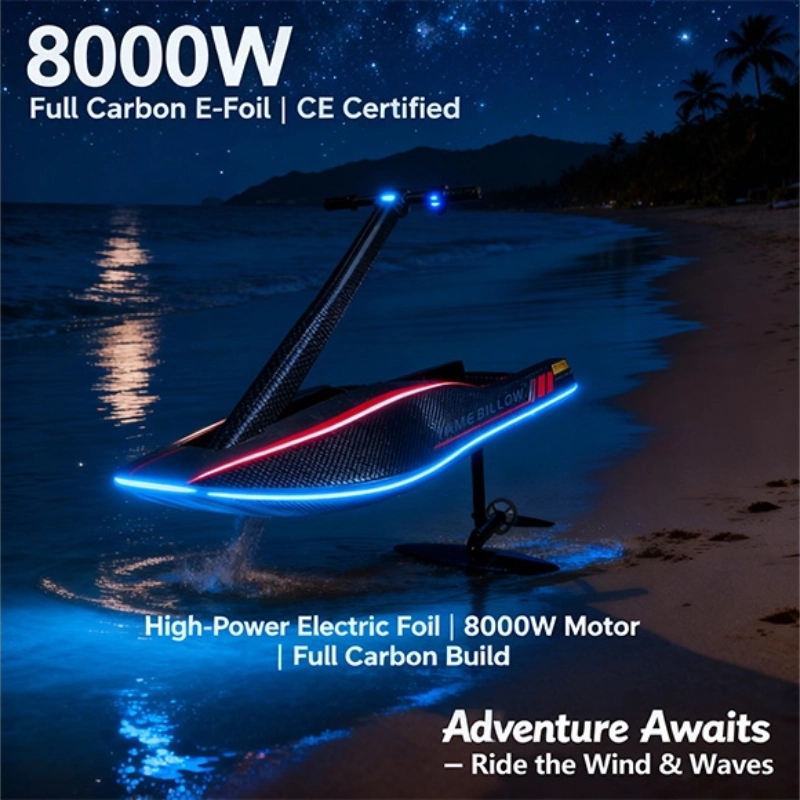 |
Color: Black or customized BoardBoard Material: EPS core + Carbon fiber+epoxy resin Motor powerWattage: 8000W or customized Remote ControlFeatures: Wireless remote controller or via handbar |
How Beginners Can Use an eFoil
Your first session on an electric hydrofoil will be memorable, challenging, and ultimately exhilarating. Approaching the learning curve methodically will save you time and save you from unnecessary crashes.
Step 1: Safety and Environment Preparation
Before touching the water, equip yourself properly. An impact vest (which doubles as a personal flotation device) and a water sports helmet are non-negotiable. Choose your location wisely: a calm, flat-water lake or a quiet bay is ideal. Ensure the water is at least 1.5 meters (5 feet) deep to prevent the hydrofoil from striking the bottom, which can cause severe damage to the gear and abrupt, dangerous stops.
Step 2: Belly Riding and Throttle Control
Start by lying on your stomach, much like a traditional surfer paddling out. Power on your Bluetooth controller and gently squeeze the throttle. The goal here is not to fly, but to understand the sensitivity of the trigger. Keep the nose of the board pinned down by keeping your weight forward. Steer by leaning your shoulders left and right.
Step 3: The Kneeling Transition
Once you are comfortable with the throttle on your belly, it is time to transition to your knees. Wait for the board to gain a steady, moderate speed. Keep your weight focused on the front of the board (near the nose). If your weight shifts backward while kneeling, the wing will generate lift prematurely, and the board will shoot out from under you. Ride on your knees, practicing gentle turns and maintaining a constant, unwavering speed. Consistency in your trigger finger is the most critical skill to develop at this stage.
Step 4: Standing Up and Taxiing
From the kneeling position, bring your front foot forward and place it where your front knee was. Then, stand up, keeping your knees bent, back straight, and eyes looking forward at the horizon—never stare down at the nose of the board. At this point, keep your weight heavy on your front foot. You want the board to stay flat on the water (taxiing). Get comfortable riding standing up while the board is still plowing through the water.
Step 5: Achieving Liftoff
When you are ready to fly, ensure you are moving at an adequate speed. Gradually shift a small amount of weight from your front foot to your back foot. Do this slowly. You will feel the board begin to rise. As soon as you feel the board detach from the water’s surface, immediately shift your weight back to your front foot to level out.
The biggest mistake beginners make is panicking and letting off the throttle when the board lifts. Letting off the throttle instantly destroys the lift, resulting in a sudden drop and a splash. You must maintain constant speed and control your altitude entirely through subtle shifts in your body weight.
How to Master the eFoil
Once you can consistently take off, fly in a straight line for long distances, and land safely, you have graduated from the beginner phase. The intermediate stage is about unlocking the true potential of the equipment, focusing on maneuverability and efficiency.
Mastering the Turn
Turning an eFoil while in flight requires a delicate balance of pitch (nose up/down) and roll (leaning left/right).
-
Heel-side Turns: For regular-footed riders, leaning back on your heels will turn the board left.
-
Toe-side Turns: Pressing your toes down will turn the board right.
When you initiate a turn, the board naturally wants to drop because the lift vector is no longer pointing straight up. To counter this, you must apply slightly more pressure to your back foot during the apex of the turn to maintain altitude. It requires a fluid, full-body motion, utilizing your hips and shoulders rather than just your ankles.
Battery Life Management
As you become more comfortable, you will want to extend your sessions. Battery life is heavily dependent on how you ride. Taxiing on the surface of the water creates immense drag and drains the battery rapidly. Flying high on the mast reduces drag significantly. To maximize your ride time, get into flight quickly, maintain a consistent cruising speed rather than constantly accelerating and decelerating, and use a high-aspect front wing (a wing that is wide but narrow from front to back), which glides through the water with minimal resistance.
Riding in Chop and Swell
Flat water is great for learning, but natural bodies of water are rarely perfectly still. When riding in choppy water, you must learn to “absorb” the bumps. Keep your knees bent and act as your own suspension system. When riding over boat wakes or small ocean swells, you need to read the water ahead of you. As you approach a swell, shift your weight forward to prevent the wing from breaching out of the wave’s back.
How to Become an eFoil Expert
For the dedicated rider, the journey doesn’t end at simple cruising. Expert eFoiling blurs the line between powered watercraft and traditional surfing.
Flagging Out and Surfing Swells
One of the most thrilling expert techniques is surfing ocean swells or large boat wakes without using the battery. Advanced riders use a specialized folding propeller. They will power into a wave, catch the natural momentum of the swell, and completely release the throttle. The propeller folds back to eliminate drag, and the rider uses pure wave energy to glide, pumping their legs to generate speed just like a traditional foil surfer. This requires impeccable balance, timing, and a deep understanding of wave mechanics.
Aggressive Carving and Breaching Returns
Experts utilize small, highly maneuverable wings and long masts (85cm+) to execute incredibly sharp, aggressive turns where the rail of the board nearly touches the water. Furthermore, they learn to master the “breach recovery.” When pushed to the limit, the front wing may accidentally break the water’s surface. While this means an instant crash for a beginner, an expert knows how to instantly shift their weight forward to slam the wing back underwater, catching the glide before completely falling.
Jumps and Freestyle
While it puts immense stress on the equipment, expert riders are now executing jumps, backflips, and aerial spins. This involves accelerating to a high speed, abruptly shifting weight back to pop the board out of the water, and using the momentum to catch air. Due to the weight of the board and battery (often exceeding 30kg), freestyle eFoiling requires immense physical strength, perfect timing, and heavily reinforced equipment.
eFoil Maintenance and Care
An electric hydrofoil is a premium, high-tech piece of equipment that operates in a hostile environment (water, especially saltwater). Proper maintenance is vital to ensure longevity and safety.
-
Freshwater Rinse: After every session, especially in the ocean, rinse the entire setup with fresh water. Pay special attention to the mast connections, the motor pod, and the propeller area to prevent salt crystallization and corrosion.
-
Contact Points: Periodically apply a marine-grade anti-seize paste or specialized grease to all screws and bolts. Stainless steel screws combined with aluminum masts can cause galvanic corrosion, fusing the pieces together if not properly lubricated.
-
Battery Care: Never store your battery fully charged or completely depleted for long periods. If storing for the winter, keep it at around 50% capacity in a cool, dry place. Always inspect the battery casing and the board’s waterproof seals for any signs of wear, sand, or debris before connecting the power.
Conclusion
The rise of eFoiling represents one of the most exciting developments in modern outdoor recreation. It offers a unique blend of adrenaline, tranquility, and physical engagement. While the learning curve can seem steep during the first few falls, the moment you finally find that balance point and silently lift off the water is a feeling of pure magic that you will never forget. By understanding your equipment, respecting the safety protocols, and progressing patiently through the beginner and intermediate stages, you will unlock a lifetime of incredible experiences on the water. Grab a board, charge your battery, and prepare for takeoff.
FAQ
1. Is eFoiling dangerous for beginners, and do I need prior surfing experience?
While prior experience in board sports (like surfing, snowboarding, or wakeboarding) can help with balance, it is absolutely not required to learn. Efoiling is generally safe as long as you wear the proper protective gear (helmet and impact vest), choose a deep, calm body of water, and learn with a beginner-friendly setup (large board and large wing). Most crashes occur at low speeds, and the water provides a soft landing.
2. How long does the battery last on a single charge?
Ride time varies greatly depending on the rider’s weight, the wing size, the water conditions, and riding style. However, on average, a standard high-capacity battery will provide anywhere from 60 to 120 minutes of continuous riding. Lighter riders gliding efficiently at medium speeds will get the longest times, while heavier riders constantly accelerating or taxiing on the surface will drain the power much faster.
3. Can I use an eFoil in the ocean, or is it only for flat lakes?
You can absolutely ride in the ocean! While flat lakes are highly recommended for the learning phase due to the predictable surface, advanced riders often prefer the ocean. Once you have mastered the basics, navigating ocean swells, jumping small waves, and even surfing breaking waves using the motor to catch them makes for an incredibly dynamic and exciting riding environment. Always ensure you thoroughly rinse your gear with fresh water after ocean use to prevent saltwater corrosion.
